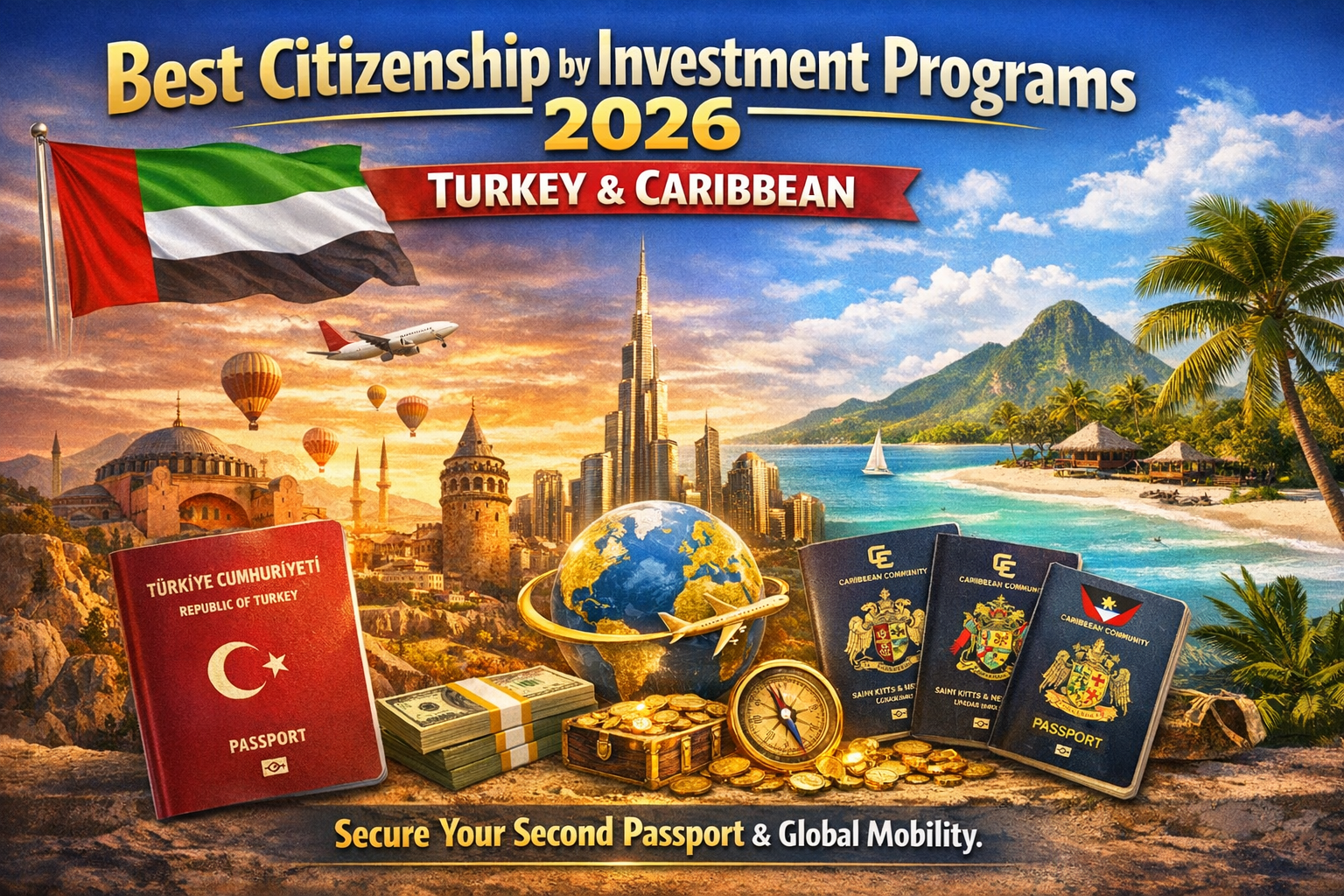
In 2026, the leading citizenship by investment programs balance speed, cost, and strategic benefits. From Turkey’s dynamic real estate pathway to the Caribbean’s established donation routes, these investment passport options deliver expedited second passports, enhanced global mobility, and business-friendly advantages without rigid residency requirements.
Turkey Citizenship by Real Estate (Best for strategic business access)
Turkey’s citizenship by investment program requires a minimum real estate purchase of $400,000. Buyers may combine multiple properties to meet the threshold if a government-approved valuation confirms the total. The Turkish passport grants visa-free or visa-on-arrival access to 126 destinations and positions investors at the crossroads of European and Asian markets — an attractive option for entrepreneurs and cross-border business expansion. Source: kurucuk.com
Caribbean Citizenship Options (Fast, predictable donation routes)
Caribbean programs remain highly popular in 2026 for predictable processing and family-friendly options. Minimum donation thresholds for single applicants now start at $200,000. Highlights:
- Dominica & St. Lucia: Citizenship typically in 3–4 months; reliable and cost-effective.
- Grenada: $235,000 donation; unique access to the US E-2 treaty investor visa.
- Antigua & Barbuda: Strong value for families at $230,000. Source: nextgenerationequity
Global Fast-Track & Low-Cost Alternatives
- Vanuatu: The fastest program historically — approvals in 45–60 days for a $130,000 donation.
- São Tomé and Príncipe: Newly affordable option in 2026 with a $90,000 contribution.
- Malta: Premium pathway to full EU citizenship via the Exceptional Investor Naturalization framework for high-net-worth investors seeking EU rights. Source: harpergreene
Investment Program Comparison (How to choose)
When comparing programs, weigh required capital against travel freedom, business access, processing time, family inclusion, and tax/residency implications. Below is a concise comparison of leading 2026 options (minimum investments and visa access):
- Turkey — $400,000 (Real estate) — Visa-free to 126 destinations. Source: kurucuk.com
- St. Kitts & Nevis — $250,000 (Donation) — 150+ destinations. Source: lnh-properties
- St. Lucia — $240,000 (Donation) — 140+ destinations. Source: lnh-properties
- Grenada — $235,000 (Donation) — 148 destinations, E-2 visa access. Source: lnh-properties
- Antigua & Barbuda — $230,000 (Donation) — 148 destinations, family-friendly. Source: lnh-properties
- Vanuatu — $130,000 (Donation) — 113 destinations, fastest approvals. Source: lnh-properties
Next Steps & Due Diligence
Before proceeding, confirm up-to-date program rules, processing times, and government fees with official program offices or licensed agents. Conduct thorough legal, tax, and source-of-funds due diligence to ensure compliance and to protect your investment.
Are you primarily focused on securing a profitable real estate asset through citizenship, or is your main goal maximizing visa-free travel at the lowest cost?
Frequently Asked Questions on Citizenship Programs:
What is the Turkey citizenship by investment program?
Turkey’s program grants citizenship to foreign investors who meet qualifying investment criteria, most commonly by purchasing real estate worth at least $400,000 and holding it for the required period.
What is the minimum real estate investment for Turkish citizenship in 2026?
The minimum is $400,000 in real estate, confirmed by a government-approved valuation report. Multiple properties may be combined to meet the threshold.
How long does the Turkish citizenship process take?
Typical processing times range from 3 to 6 months after submitting a complete application and required documents, though timing can vary by case.
Do I need to live in Turkey to qualify for citizenship?
No. The Turkish investment passport does not require long-term residency prior to naturalization, though investors must comply with property ownership and holding-period rules.
Can family members be included in the application?
Yes. Spouses and dependent children (typically under 18, with some flexibility up to 25 for students) can be included; specific age limits and requirements should be confirmed with authorities or licensed agents.
What documents are required for application?
Common documents include a passport, birth certificate, marriage certificate (if applicable), police clearance, health report, proof of funds/source of funds, and the government-approved real estate valuation.
Is proof of source of funds required?
Yes. Applicants must demonstrate legitimate source of funds for the investment (bank statements, sale contracts, business records). Due diligence and anti-money-laundering checks are standard.
Do I get visa-free travel with a Turkish passport?
A Turkish passport offers visa-free or visa-on-arrival access to around 126 destinations (numbers can change—confirm current visa lists before travel).
Can I sell the property after obtaining citizenship?
Properties tied to citizenship usually must be held for a mandatory holding period (commonly three years). Verify current rules before selling.
Are there tax implications for Turkish citizens?
Tax residency depends on time spent and ties to Turkey. Turkish citizens may have tax obligations; consult a tax advisor for residence and taxation impact.
Does Turkey allow dual citizenship?
Yes. Turkey permits dual citizenship, but applicants should verify whether their home country allows dual nationality.
How do I apply and who can help?
Apply through licensed immigration agents, lawyers, or authorized real estate developers who handle paperwork, government approvals, and valuations. Always use accredited professionals and confirm fees upfront.
How can I verify program updates and legal changes?
Check official Turkish government sources (Interior Ministry, Directorate General of Migration Management, or land registry offices) or consult licensed immigration lawyers for the latest regulations.


 English
 Türkçe
 فارسی
فارسی العربية